

Virtual Reality: what it is and how it works

Written by
Team KeyWe
Virtual Reality
Technological research
Let's discover this immersive technology and its possible applications together.
What is Virtual Reality (VR)
Virtual Reality is a technology that simulates fully digital, three-dimensional, dynamic environments. These are real parallel worlds, either realistic or imaginary, that people can immerse themselves in and interact with.
These simulated environments are created by sophisticated computers, while wearable devices are needed to experience and explore them.
First and foremost among these is the VR headset. With the headset on their face, people isolate themselves from the outside world and experience the digital environment with total immersion. The immersive effect is amplified when special suits and gloves are worn, which send sensory stimuli and use movement to interact with the virtual space.
Through ever-improving visual quality and increasingly sophisticated wearable technologies, Virtual Reality aims to simulate reality in a totally convincing way. From wherever they are, simply by wearing a headset, people are transported to another universe, with potentially infinite scenarios in which to enjoy any kind of experience.
How Virtual Reality works
A fluid and immersive experience is achieved thanks to high-resolution images, wearable devices and high-performance technologies.
Virtual Reality is experienced by wearing a headset.
This is equipped with:
- an accelerometer
- a magnetometer
- a gyroscope.
Together, these components enable a feature called “Head Tracking”: the image moves smoothly, in sync with head movements, along the four cardinal points. Response times are between 50 and 30 ms. The result is a simulated movement in virtual space that is perfectly realistic.
To offer a satisfying and high-performance experience, the headset must have certain important specifications regarding:
- Field of view;
- Frame rate;
- Eye tracking;
- Audio system.
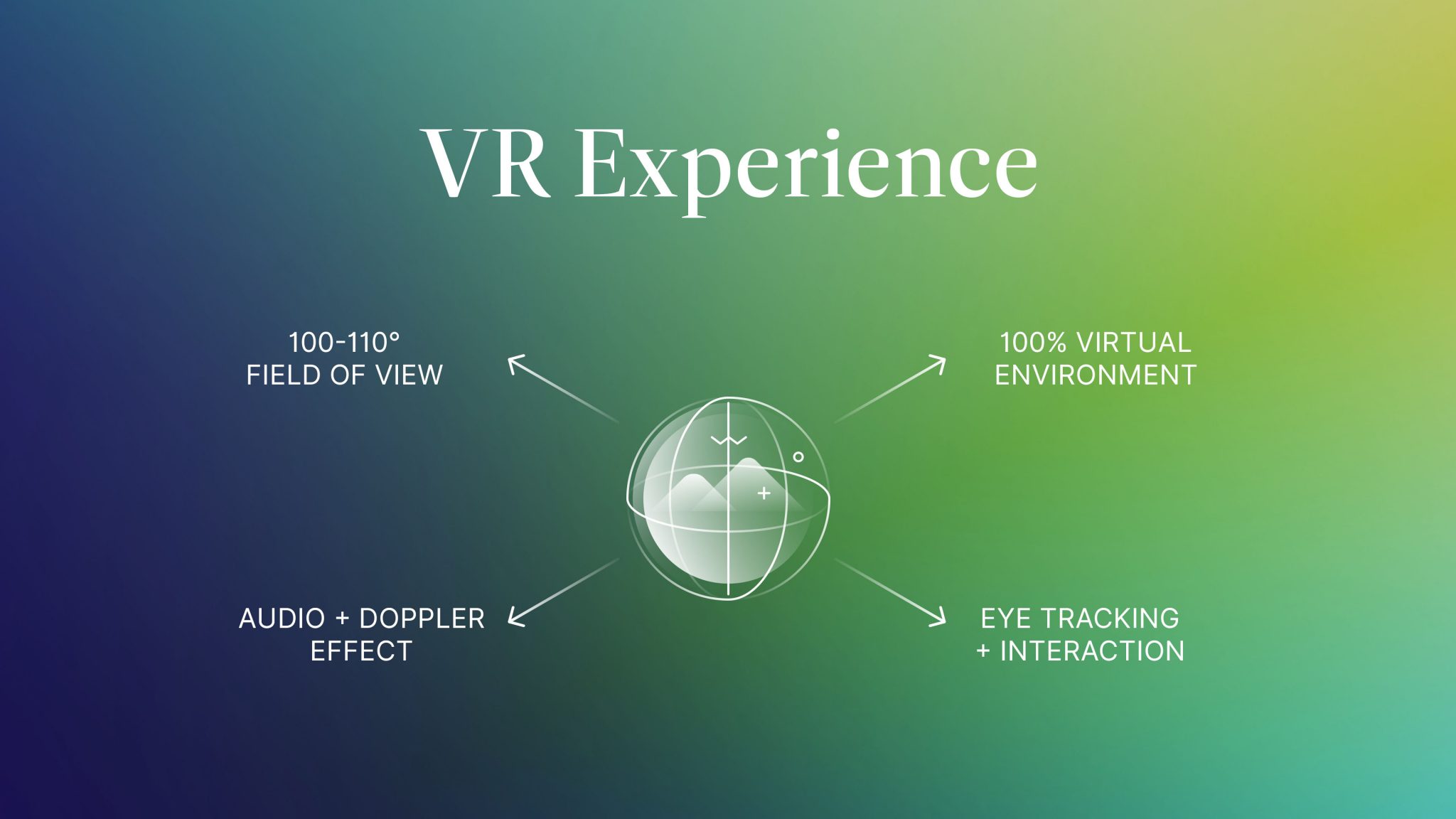
The ideal field of view is between 100 and 110 degrees, while the frame rate, i.e. the frequency of image projection per second, should be between a minimum of 60 fps and a maximum of 120 fps. These values prevent jerky vision, which is uncomfortable for the eyes. A sophisticated infrared pointing system, known as “Eye Tracking”, reads the user’s eye movements and adjusts the depth of field accordingly.
The virtual experience also includes surrounding sounds. It is essential that the headset has a professional multi-channel audio system that reproduces sounds coming from all directions. This system also allows the creation of the “Doppler effect”: the sound is more intense when close by and decreases as you move away, for greater realism.
To make the experience even more immersive, other devices are used, such as controllers and gloves, which allow you to interact with the virtual environment as you would with your hands in the real world. The headset and controllers are connected to a computer or mobile device (Standalone) that synchronises the images with the user’s movements.
Virtual Reality: objectives and applications
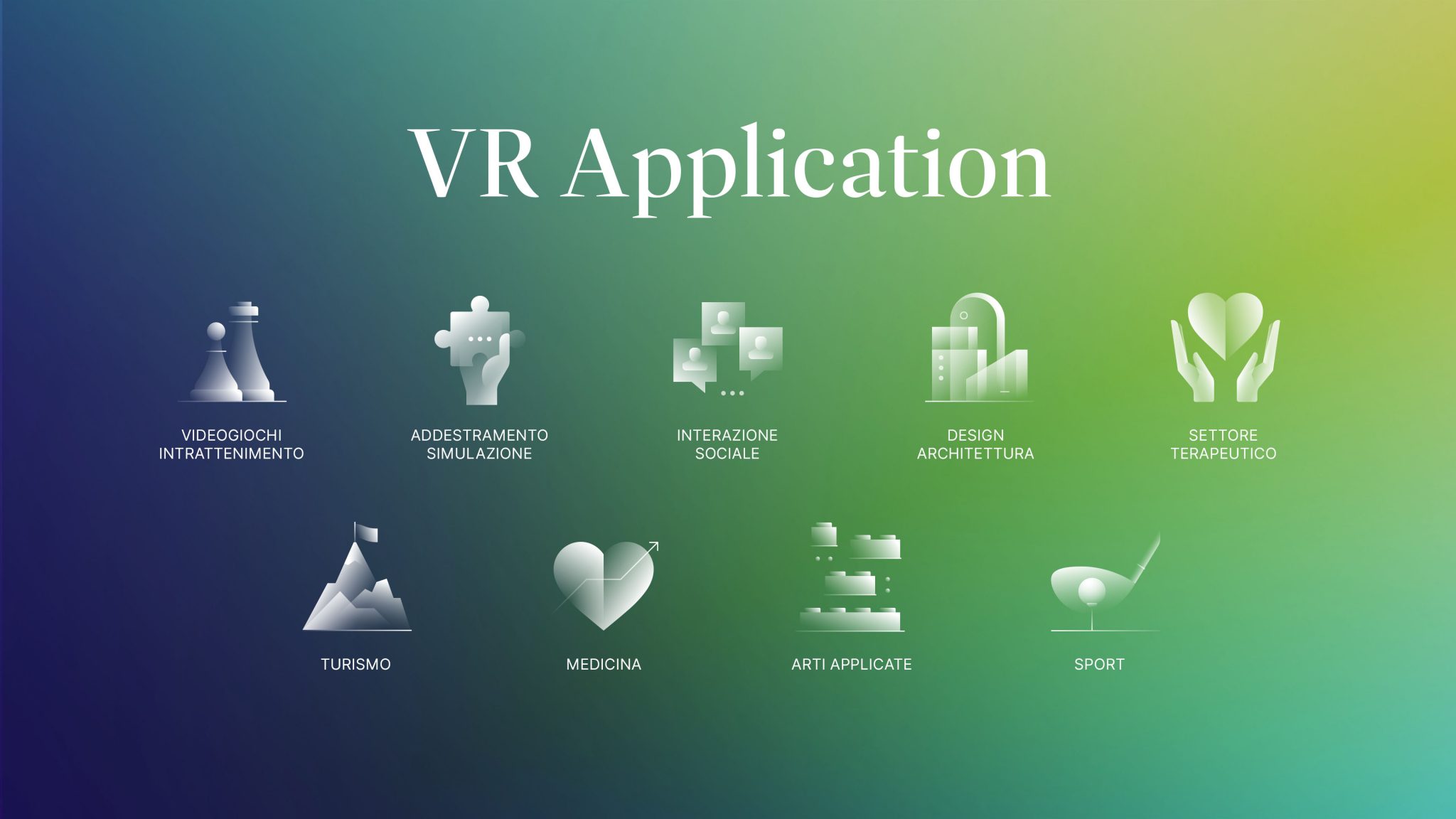
Virtual Reality is a versatile technology that can be applied in various fields and is already revolutionising entire sectors:
- Video games and entertainment: immersive experiences in fantasy worlds;
- Training and simulations: military, medical and industrial personnel can train in complete safety, in simulated but realistic environments;
- Social interaction: people can meet and work in shared virtual environments;
- Design and architecture: projects can be visualised with great realism;
- Therapy: phobias and post-traumatic stress disorders can be treated in virtual environments;
- Tourism: exotic locations and historical sites can be visited virtually;
- Medicine: surgical planning, pain management;
- Applied arts: a means of expression for contemporary artists;
- Sport: training and simulations.
Discover our VR Experience created for MSC
What to expect from the future: the choices made by Apple and Meta
Apple and Meta are engaged in the development of Virtual Reality headsets. Both technology giants see Virtual Reality as the next frontier in human interaction and digital experience, and are investing significant resources to bring these devices to the general public.
Apple has already announced the imminent release of a headset suitable for all immersive AR/VR/MR technologies. Meta, on the other hand, has unveiled the Oculus Quest 3 headset with the aim of creating a “Metaverse” in which to enjoy social and professional experiences.
Virtual Reality: challenges and future
Along with enthusiasm, Virtual Reality also brings doubts and challenges, which are inevitable in the process of technological innovation.
The threat that many foresee is a gradual detachment from everyday reality. In the virtual world, desires can be satisfied and a better quality of life seems within reach.
The potential of Virtual Reality has been feeding the collective imagination for some time. Countless films have depicted technologies capable of blending reality and fiction, challenging the human ability to distinguish between the two worlds. From the famous Total Recall in 1990 to the more recent works of Steven Spielberg and Christopher Nolan, via cult classics such as The Matrix and Avatar.
In the future, it will be essential to find a balance between virtual immersion and real life. Only through ethical and responsible use can Virtual Reality offer value without compromising everyday life in the real world.
KeyWe’s approach
KeyWe is your strategic partner for exploring the potential of new technologies. Our Virtual and Augmented Reality agency has already created physical-digital experiences for commercial events, in which products and services are presented in an immersive and memorable way.
Day after day, the agency supports companies in selecting the most suitable technology for their various marketing objectives. The solutions developed are always user-centred and meticulously detailed. The approach is consultative, and the result is always personalised.
Written by
Team KeyWe